

.png)
.png)


Why AI Models Alone Do Not Deliver Digital Transformation

An organisation can have capable AI models and still experience very little business transformation.
The reason is structural. AI can classify, summarise, extract, recommend, and automate parts of a task, but it cannot repair fragmented records, define ownership, establish authoritative information, redesign a weak process, correct access controls, or create staff adoption on its own.
That is the point behind the incomplete bridge. Leaders invest in AI and expect better decisions, improved service, efficient operations, stronger control, and innovation. The digital-transformation bridge stops halfway when the supporting organisational structure has not been built.
For organisations in Jamaica and across the Caribbean, the management question is not only whether an AI tool works. It is whether the information, processes, controls, technology environment, and people needed to support it are ready.
The bridge is digital transformation, not AI implementation
An AI project may prove that a model can perform a task. Digital transformation changes how work is completed, how information is controlled, how decisions are made, how risk is managed, and how customers or citizens are served. When the wider operating structure is incomplete, the bridge cannot carry the expected business load.

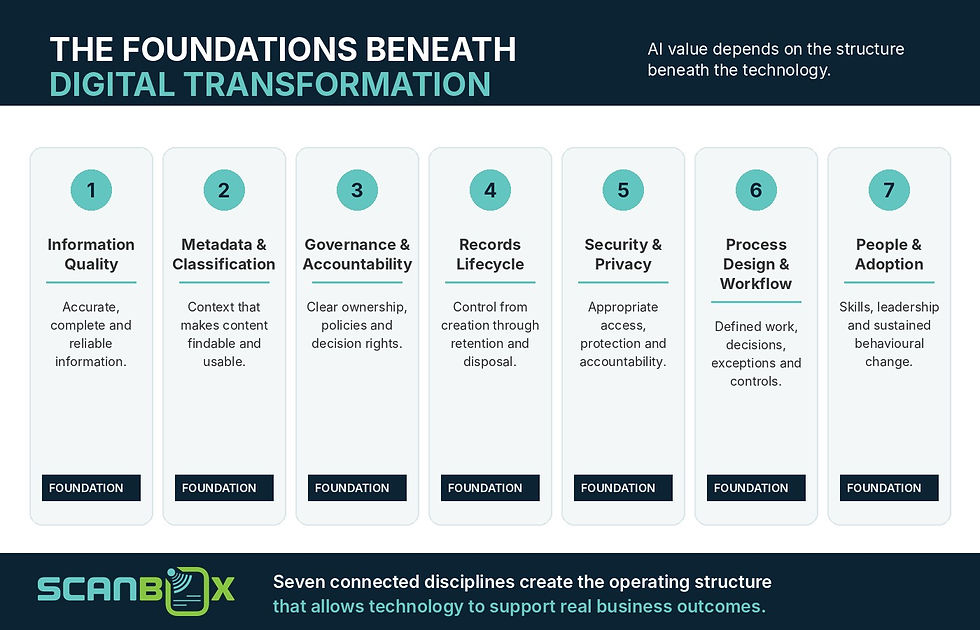
Seven foundations that carry digital transformation
1. Information capture and quality
AI depends on the information available to it. Important information may remain spread across paper files, shared drives, email, spreadsheets, scanned images, business applications, and legacy repositories. Structured digitization and intelligent capture add preparation, OCR, indexing, validation, quality assurance, exception handling, and secure transfer so digital content can be trusted and used.
2. Metadata, classification, and context
AI can process text, but business decisions require context. Metadata explains what a document is, who or what it relates to, when it was created, its status, its owner, and the process it supports. Classification and information architecture make those relationships consistent across teams and repositories.
3. Governance, ownership, and accountability
Digital transformation requires clear ownership, decision rights, policies, stewardship, oversight, issue management, and escalation. Governance must shape how information is created, captured, accessed, retained, shared, automated, and used.
4. Records lifecycle and authoritative sources
An organisation must know which information is an official record, which version is authoritative, how long it should be retained, and when disposal is authorised. AI and automation should not rely on obsolete, duplicated, incomplete, or unmanaged content.
5. Security, privacy, and controlled access
AI increases the speed and scale at which information can be found and used. Organisations must define who should see particular information, for what purpose, under what conditions, and with what level of auditability.
6. Process redesign, workflow, and automation
Before automating work, define the required steps, decisions, responsibilities, exceptions, controls, service expectations, and intended outcome. Automating an unresolved process usually moves confusion faster and makes accountability harder to trace.
7. People, education, change, and adoption
Staff need to understand the new process, the information rules, the system, their responsibilities, and the reason for the change. Leaders must reinforce the operating model, monitor adoption, address resistance, and correct workarounds that weaken the intended control.
What happens when the foundations are incomplete
When these foundations are missing or uneven, an organisation may receive confident answers based on outdated records, automate workflows built around weak approvals, expose sensitive information too broadly, or complete a digitization project that still leaves employees unable to retrieve the correct document. These are not failures of the model alone. They are signs that the digital-transformation structure is unfinished.
A practical sequence for building the bridge
Start with the business outcome, decision, service, or workflow that must improve.
Identify the information that supports it and where that information currently resides.
Establish ownership, authoritative sources, metadata, classification, quality, access, privacy, retention, and security requirements.
Redesign the process and define responsibilities, decisions, exceptions, and controls.
Select and configure the appropriate combination of digitization, Enterprise Content Management, workflow, automation, and AI.
The management question before the next AI investment
Can the organisation identify its authoritative information, explain its context, control access, manage its lifecycle, connect it to a defined process, and support staff adoption? Where the answer is uncertain, the next priority may be completing the digital-transformation structure that allows AI to contribute safely and effectively.
ScanBox helps organisations improve how information is captured, classified, governed, protected, accessed, retained, and used. We combine information management, structured digitization, Enterprise Content Management, records and retention management, workflow automation, governance, and implementation support to strengthen the foundations of digital transformation.
Digital Transformation Made Simple.
Strengthen the foundations supporting your digital and AI initiatives
Talk to ScanBox about the information, governance, content, process, security, and adoption conditions affecting your organisation's digital-transformation goals.
Frequently asked questions
Why do AI initiatives fail to create business transformation?
AI initiatives may stall when the organisation has fragmented information, unclear ownership, weak governance, inconsistent processes, poor access controls, unreliable records, or low adoption. The model may work technically while the operating environment remains unchanged.
Is AI implementation the same as digital transformation?
No. AI implementation introduces a tool or capability. Digital transformation changes how information, processes, technology, controls, people, and decisions work together to produce business outcomes.
How does information management support AI?
Information management improves capture, classification, metadata, access, quality, lifecycle control, and retrieval. These disciplines help people and systems use more reliable and appropriately governed information.



Comments