

.png)
.png)

The Value of Information Is in Its Use

The Value of Information Is in Its Use
Organisations do not create value simply by storing more documents, collecting more data or adding more digital files to a repository.
The value of information is realised when people can find the right information, trust it, understand its context and use it to take the right action.
This belief sits at the centre of how ScanBox approaches information transformation:
The value of information is realised through its use. Information must be easy to find, trusted, governed and ready to support action.
It is a simple philosophy, but it has significant implications for how an organisation handles records, technology, risk and daily work.
A records room may contain decades of institutional knowledge. A shared drive may hold contracts, reports, invoices, forms and correspondence. Yet these assets cannot create their full value when employees cannot locate the correct record, determine whether it is current, understand who may access it or know what should happen next.
Information delivers value through use, not accumulation.
Storage preserves information. It does not make information useful.
Organisations need reliable places to keep records, evidence and operational content. They must protect that information and retain it for the appropriate period. But storage is only one part of the information lifecycle.
Consider a customer request that requires an employee to find an agreement, confirm its current version, review an approval and determine the next action. If those items are spread across paper folders, email, shared drives and individual desktops, the employee first has to reconstruct the record before completing the task.
The organisation has the information, but it is not operationally ready.
That gap appears in many forms:
Staff search several locations for one complete file.
Teams rely on different versions of the same document.
A scanned document has no useful name, index or metadata.
Access or retention decisions depend on one person.
A process stalls because the information and required action are disconnected.
The issue is frequently a lack of structure, context, control and accessibility.
Unstructured data is where much of an organisation’s value becomes trapped
Much of the information used in everyday business does not begin in a neatly organised database. It exists as paper records, emails, PDFs, scanned images, contracts, reports, forms, photographs, presentations, correspondence and files stored across shared drives and individual devices.
This is unstructured data. It may contain names, dates, obligations, approvals, decisions and institutional knowledge, but those details are not consistently labelled or connected to the organisation’s systems and processes. A person may be able to read a document and understand its importance, while the organisation still cannot reliably search, classify, govern or act on it at scale.
That is why converting paper to PDF is not enough. A digital file can remain as difficult to use as the physical record it replaced when it has no meaningful title, searchable text, metadata, classification, owner, access rule or link to a workflow.
The objective is not to force every document into a rigid format. It is to give unstructured information enough structure and context to become useful. Optical character recognition can make content searchable. Metadata can connect it to a customer, case, transaction or date. Classification can establish what it is. Governance can determine who may use it and how long it should be retained. Workflow can connect it to the next action.
When these elements work together, previously fragmented content becomes information that employees can find, trust and use.
Data becomes useful information through relevance and purpose
Management thinker Peter Drucker distinguished raw data from information with relevance and purpose. In his writing on the information-based organisation, he anticipated businesses in which knowledge workers would depend on organised information. His larger point remains useful: collecting data is not the same as equipping people to perform.
That distinction is increasingly important.
An invoice image is data. An invoice connected to the correct supplier, purchase order, approval status, payment date and retention rule is useful business information.
A customer form is data. A verified form connected to the correct account, authorised users, consent record and next service action becomes operationally useful.
A policy document is data. An approved policy with an owner, version, effective date, review cycle and controlled distribution becomes a governance instrument.
Relevance comes from context. Purpose connects the information to a business need, obligation, decision or action.
An information-transformation initiative should not begin by asking only, “What should we scan?” or “Which system should we buy?” Leaders should also ask:
Who needs this information?
What must they know about it?
How quickly must they find it?
Which version should they trust?
Who may view, change, approve or share it?
What decision, workflow or obligation does it support?
How long should it be retained, and what happens at the end of that period?
Those questions turn a storage project into an information-management programme.
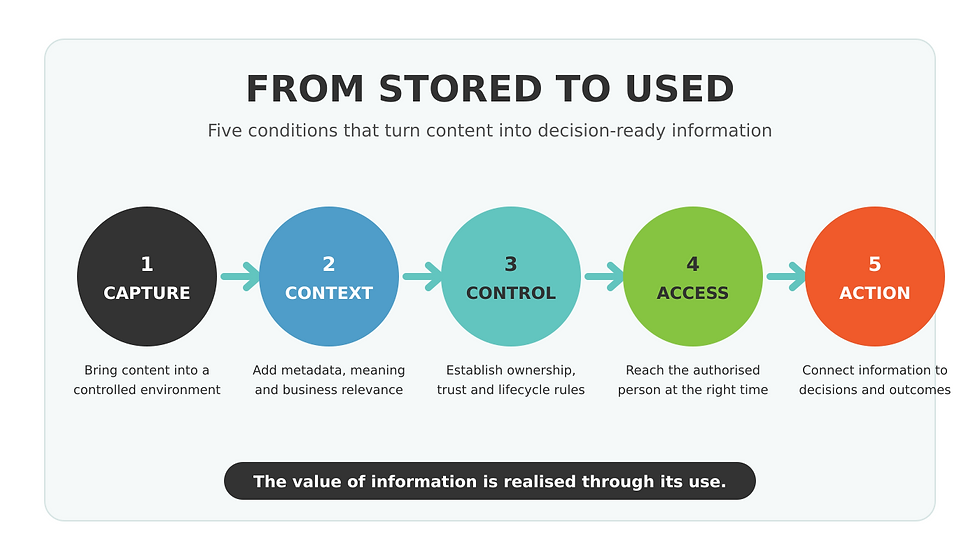
Five conditions turn stored content into usable information
For information to support work consistently, five conditions should operate together.
1. Capture
Information must first enter a controlled environment. For paper and unstructured documents, this may involve preparation, scanning, optical character recognition, indexing and quality assurance.
Scanning creates a digital image. Structured digitisation makes the content usable by adding the controls needed for retrieval, validation and downstream processes.
2. Context
A file name alone rarely provides enough context.
Metadata connects a document to the business. It may identify the customer, document type, date, department, status, owner or case. Classification places the information within a logical structure.
Good metadata helps people search by what the information means, not merely where someone saved it.
3. Control
Useful information must also be trustworthy. Governance defines ownership, authorised access, version control, quality, retention, disposal and accountability. These controls help employees determine whether a record is complete, current and appropriate.
Without governance, faster access can simply spread incorrect, outdated or sensitive information more quickly.
4. Access
Information has limited operational value when authorised people cannot retrieve it at the point of work. Employees should not need to know which cabinet, inbox or folder holds a record before they can find it. They should be able to search using the business context they already know.
The goal is not unrestricted access. It is the right information reaching the right authorised person at the right time.
5. Action
The final test is whether the information supports an outcome.
Can a request be answered, an approval move forward or a manager see an exception? Can the organisation demonstrate what happened and which evidence supported the decision?
Information becomes an active business asset when it is connected to workflows, responsibilities, deadlines and decisions.
Digitisation should be designed around use
Many digitisation programmes focus heavily on boxes collected, pages scanned or files uploaded. Those figures help with project control, but they do not prove that the organisation can use the information effectively.
A better digitisation design begins with the intended use.
If staff retrieve files by account number, document type and date, those requirements should shape the indexing model. If a workflow depends on contract expiry dates, that information should be captured and validated. Sensitive records also need access and handling controls before broad availability.
Quality assurance also needs to reflect use. A clear image is still operationally weak when attached to the wrong customer, indexed incorrectly or missing a page.
Success means an authorised user can retrieve correct, complete and trusted information when the business needs it.
Governance protects value rather than restricting it
Information governance is sometimes viewed as an administrative burden. In practice, good governance enables confident use.
Clear ownership identifies who can resolve a quality issue. Consistent classification improves search. Role-based access protects sensitive information without blocking legitimate work. Retention controls preserve required evidence and address information that no longer has a valid business or legal purpose.
Governance prevents two costly extremes:
keeping everything without structure or accountability
restricting information so heavily that legitimate work becomes slow and dependent on informal workarounds
The objective is controlled usefulness.
This matters for Jamaican and Caribbean organisations operating across physical records, email, shared drives, legacy systems and cloud applications. The management requirement is the same: information needs an owner, a purpose, appropriate controls and a clear relationship to work.
Information readiness comes before automation and AI readiness
The same philosophy applies to automation and artificial intelligence.
Automation cannot reliably route work when document types, ownership and decision rules are unclear. AI cannot compensate for missing context, weak access controls, conflicting versions or poor-quality source information.
Before asking what AI can do with organisational information, leaders should ask whether that information is:
accessible to the appropriate people and systems
classified in a consistent way
supported by useful metadata
governed throughout its lifecycle
protected according to its sensitivity
complete and reliable enough for the intended use
connected to a defined process, question or decision
AI readiness begins with information readiness.
Organisations do not need a perfect information environment before they improve. They should tie technology choices to specific information conditions and business outcomes, address high-friction processes first and build from evidence.
A practical test for leaders
Choose one information-dependent process, such as responding to a customer, approving an invoice, reviewing a contract or preparing a report.
Then ask:
Where does the required information originate, and how many places must an employee search?
How does the employee know the record is complete and current?
What metadata or classification makes it findable?
Who may access, update or approve it, and which controls apply?
What action should it trigger, and can the organisation demonstrate what happened?
The answers reveal whether information is functioning as a business asset or remaining a passive store of content.
Make information work
The goal of information management is not to create a larger digital archive. It is to give people reliable access to the information they need to perform, serve, govern and decide.
That requires more than scanning. It requires the right combination of capture, metadata, classification, governance, security, lifecycle control, workflow and adoption.
At ScanBox, we help organisations convert fragmented and unstructured information into secure, governed, searchable, automated and decision-ready information ecosystems.
Because the value of information is realised through its use.
Is your organisation storing information, or enabling people to use it?
ScanBox Limited Digital Transformation Made Simple.
Frequently asked questions
What makes information valuable to an organisation?
Information becomes valuable when it is relevant to a business need, reliable enough to trust, accessible to authorised users and connected to a decision or action.
Is scanning the same as information management?
No. Scanning creates a digital representation of a document. Information management adds classification, metadata, quality control, access, governance, retention and workflow so the content can be used effectively.
Why is metadata important?
Metadata provides business context. It helps users identify, search, filter, govern and connect information without relying only on file names or folder locations.
What is unstructured data?
Unstructured data is information that does not follow a consistent predefined data model. In organisations, it commonly includes paper records, emails, PDFs, scanned images, contracts, reports, forms and correspondence. It becomes more useful when searchable text, metadata, classification, governance and workflow connect it to a business purpose.
How does information governance improve access?
Governance defines ownership, classification, permissions, version control, quality, retention and accountability. These controls help authorised users find and trust the correct information while protecting sensitive content.
Why does AI readiness depend on information readiness?
AI systems depend on the quality, context, accessibility and governance of source information. Disorganised, incomplete or poorly controlled information can produce unreliable outputs and introduce operational or security risks.


Comments