

.png)
.png)


ScanBox at 10: A Decade of Making Information Work
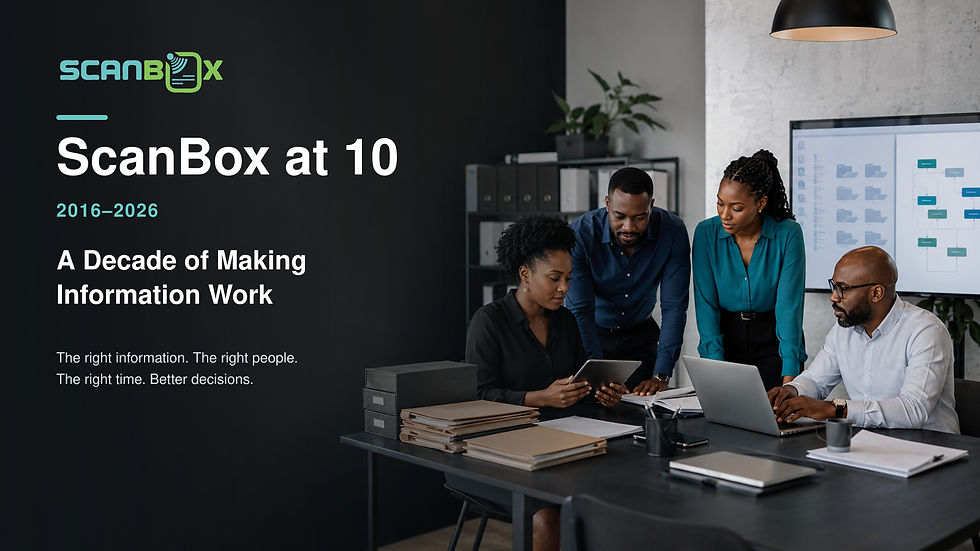
In 2026, ScanBox Limited marks ten years in business.
An anniversary is an opportunity to celebrate, but it is also a time to ask what has remained constant through the years. For ScanBox, the answer is clear.
Organisations need the right information, delivered to the right people, at the right time, so they can make the right decisions.
That principle has guided our journey. Technology has changed. Business expectations have changed. Regulatory responsibilities have increased. The volume and variety of information organisations must manage have grown significantly. Yet the fundamental challenge remains familiar.
Information may exist, but that does not mean it can be found quickly, trusted confidently, shared securely or used effectively.
For ten years, ScanBox has worked to close that gap.
The problem was never paper alone
Our journey began in an environment where many organisations depended heavily on physical records. Important information lived in filing rooms, boxes, cabinets and folders. Finding a document could require time, institutional memory and the availability of the person who knew where it had been placed.
Digitization offered a way forward, but experience quickly reinforced an important lesson. Creating an image of a document does not automatically make its information useful.
A scanned file without meaningful indexing can still be difficult to find. A digital folder without consistent classification can reproduce the confusion of a physical filing room. A repository without access controls, retention rules or ownership can create new risks even as it solves an old storage problem.
This understanding shaped ScanBox’s evolution.
We continued to help organisations convert paper and unstructured content into digital assets, but our focus expanded to what must happen after capture. Information needs structure. It needs metadata and classification. It needs quality control, security, lifecycle rules, workflow and accountability. It must connect with the way people actually work.
Digitization became a foundation for a broader purpose: information transformation.
From digital files to decision-ready information
Over the past decade, the conversation around digital transformation has moved rapidly. Organisations are now considering cloud platforms, automated workflows, data analytics and artificial intelligence. These technologies create important opportunities, but they also make the quality of the information foundation more important.
Automation cannot reliably improve a process that has not been understood. Search cannot consistently retrieve information that has not been classified. Analytics cannot create confidence from incomplete or poorly controlled data. Artificial intelligence cannot compensate for unclear ownership, weak access controls or unreliable source information.
The lesson is practical: structure before scale, and governance before automation.
ScanBox has grown into an information management and digital transformation company because our clients’ needs extend across the full information lifecycle. Today, our work brings together structured digitization and intelligent capture, records and retention management, Enterprise Content Management, information governance, data privacy, workflow automation, project delivery and change support.
The services have expanded, but the purpose has remained consistent. We help organisations make information easier to access, safer to use, better governed and more valuable to everyday operations.
Our ABC philosophy: a practical path to operational clarity
The ScanBox philosophy can be understood through three connected outcomes: Access, Business-Ready Insight and Compliance.
A is for Access
Information creates little value when authorised people cannot retrieve it when they need it.
Access begins with converting fragmented records into organised, searchable information. That requires more than placing documents in a digital location. It requires thoughtful classification, consistent metadata, indexing standards, quality assurance and permissions.
Effective access also considers context. Staff should be able to identify what a document is, which process or customer it relates to, whether it is the current version and who is authorised to use it.
When these controls work together, people spend less time searching and more time serving customers, completing processes, responding to requests and making decisions.
B is for Business-Ready Insight
Information becomes business-ready when it can support action.
Documents often contain the evidence behind transactions, approvals, obligations, customer relationships and operational decisions. When this content is fragmented across paper files, email, shared drives and disconnected applications, the organisation cannot easily see the full picture.
Metadata-driven information management brings content and context together. Workflow can route information to the appropriate person, record decisions, show status and identify exceptions. Reporting can provide greater visibility into the process. Teams can work from information that is more current, complete and verifiable.
Business-ready insight does not mean collecting more data for its own sake. It means organising information so that people can understand what is happening and decide what should happen next.
C is for Compliance
Compliance is not a document that is prepared once and stored. It is an operating discipline.
Organisations must know what information they hold, why they hold it, who can access it, how long it should be retained and what must happen when its useful or required life ends. Privacy, records management, security and governance therefore need to be built into daily operations.
This is particularly important as Jamaican organisations strengthen their practices under the Jamaica Data Protection Act 2020 and other applicable obligations. Policies matter, but operating evidence matters too. Roles, registers, access rules, retention controls, training, incident procedures and management oversight must work together.
Access, Business-Ready Insight and Compliance are not separate projects. Together, they create the foundation for sustainable digital transformation.

What ten years have taught us
Every information environment is different, but several lessons have remained consistent throughout our journey.

1. Start with the business problem
Technology should follow a clear understanding of the operational need. The starting point may be slow retrieval, limited storage, weak version control, regulatory exposure, a manual approval process or information trapped in disconnected systems.
Defining the problem helps the organisation choose an appropriate combination of people, process, information, technology and controls.
2. Design retrieval before capture
Before the first page is scanned or the first file is migrated, the organisation should decide how information will be found and used.
Naming, metadata, classification, validation and access decisions should not be postponed until the end. If retrieval is not designed early, a project can produce thousands of digital files while preserving the same search problem it was meant to solve.
3. Governance makes technology sustainable
A platform can enable search, permissions, workflows and automation. It cannot independently decide who owns the information, which rules apply or how exceptions should be handled.
Governance provides those decision rights. It establishes accountability for classification, quality, access, retention, privacy and oversight. This allows the technology to support the organisation’s operating model rather than become another disconnected tool.
4. Adoption is part of implementation
People experience digital transformation through their daily work.
If a new information system adds uncertainty, duplicates effort or does not reflect the real process, adoption will suffer. Clear roles, practical training, change support, acceptance criteria and ongoing ownership are therefore essential.
The project is not complete when the system becomes available. Value emerges when people can use it confidently and consistently.
5. Better information supports better service
Information management may appear to be a back-office discipline, but its effects reach the people an organisation serves.
When authorised staff can retrieve complete information faster, enquiries can be handled more effectively. When workflows make responsibility visible, processes can move with greater accountability. When records are protected and governed, the organisation can respond with greater confidence.
Better information helps organisations operate with more clarity, continuity and trust.
Built in Jamaica, relevant across the Caribbean
ScanBox’s journey has been shaped by the operating realities of organisations in Jamaica and the wider Caribbean.
Our region contains ambitious institutions pursuing digital service delivery while managing physical archives, legacy systems, limited resources, changing regulatory expectations and the need to maintain business continuity. The solution is rarely to replace everything at once.
Practical transformation requires priorities, sequencing and discipline. It means understanding what should be digitized, what should be governed, what should be automated and what should be retained. It means selecting technology that fits the operating environment and supporting the people who will use it.
This regional experience continues to inform how ScanBox approaches information management: understand the environment, design the controls, implement with discipline and build for sustained use.
The next decade: trusted information for an automated world
The next ten years will bring new opportunities in intelligent capture, Enterprise Content Management, workflow automation, analytics and artificial intelligence.
Our direction is not to adopt technology for appearance. It is to help organisations establish the information foundations that allow technology to create responsible and practical value.
AI readiness begins with information readiness. Organisations need content that is structured, accessible, current, appropriately secured and governed throughout its lifecycle. They need clarity about source, context, ownership and permitted use. Without these foundations, faster technology can produce faster uncertainty.
ScanBox will continue helping organisations move from fragmented records to trusted information ecosystems. We will continue connecting capture to classification, access to security, workflow to accountability, privacy to operating practice and technology to measurable business needs.
Our vision remains to become the provider of choice for information management and digital transformation solutions in Jamaica and the Caribbean.
Thank you for being part of the journey
Ten years are built through relationships.
We thank the clients who trusted ScanBox with important information challenges, the partners who expanded what we could deliver, and the team members and specialists who brought care, discipline and expertise to the work.
Every engagement has reinforced why information matters. Behind each record is a customer, transaction, service, obligation, decision or part of an organisation’s history. Managing that information well is not simply an administrative task. It is part of how an organisation earns trust and performs its purpose.
As we mark this milestone, we are proud of how far ScanBox has come and clear about the work ahead.
The mission continues: help organisations provide the right information, at the right time, to the right people, so they can make the right decisions.
That is how we make digital transformation practical.
That is how we make information work.
That is Digital Transformation Made Simple.
Ready to make your information work harder for your organisation?
If your teams are losing time searching for documents, managing disconnected records, completing manual approvals or preparing information for compliance and audit, ScanBox can help you define a practical way forward.
to discuss your information environment and the outcomes your organisation needs.


Comments